Our research into AI agent adoption draws on conversations with teams using agents and those deciding what to delegate. We have heard about untraceable changes, uncertain data access and agents consuming resources without useful progress.
Some discussions concern incidents; others expose missing safeguards or barriers to adoption. Across these conversations, teams need to establish what agents can do, who is responsible and when to stop them.
Teams cannot attribute agent activity
At a venture capital firm using AI in its investment workflows, a participant described roughly six applications updating CRM records under one person’s identity. They could not easily identify which application or person made a change. As agents enter shared-account workflows, teams need to trace each update to its caller.
An agent can choose successive actions without a person selecting every step. An unattributed change may belong to a sequence still running.
Agents can distribute information beyond intended boundaries
An agent with messaging or publishing tools can distribute information as well as read it. Our discussions included an email reaching an unintended recipient through an unexplained route and a separate deployment exposing credentials. The email’s cause remained unresolved. Teams need to check destinations and visibility before agents execute these actions.
We also heard of AI use being paused over uncertainty about whether data stayed on a user’s computer or went elsewhere. Connecting an agent requires understanding what information its tools can access and where that information goes.
A team may want an agent to read selected pages without accessing the wider workspace. Tool access and authority to share the retrieved information are separate decisions.
Agent controls can leave actions uncovered
An agent may act through several tools and connection routes. Checking one route does not cover the others. Our research identified policies for wallet actions that excluded credential use or card actions. Teams need to map each agent’s available tools against the actions their controls actually govern.
Policy conflicts can block agents’ work
A payments-infrastructure company planning agent-assisted customer onboarding told us it had no governance for that capability.
Elsewhere, an institutional wallet provider described customers accumulating more than 200 rules, with conflicts leaving transactions stuck. For agents, adding rules requires testing whether legitimate work remains possible. Teams need policies that stop prohibited actions without trapping an agent halfway through its task.
Agents can repeat work without progress
At that venture capital firm, a participant described background searches repeatedly covering the same period, consuming paid search and model resources without useful progress. An agent can continue invoking tools while the team assumes it is advancing. Limits and stopping conditions must distinguish useful work from repeated activity.
Agent changes can invalidate earlier evidence
A participant at a global insurance broking and advisory firm described internal audit opposition to agents moving cash autonomously. The same conversation raised the need for operating evidence that remains useful when models or workflows change.
That concern extends beyond financial agents. Giving any agent a new model, tool or policy can change the assumptions behind earlier testing. Teams need operating records and documented risks to judge which changes require fresh testing before granting more authority.
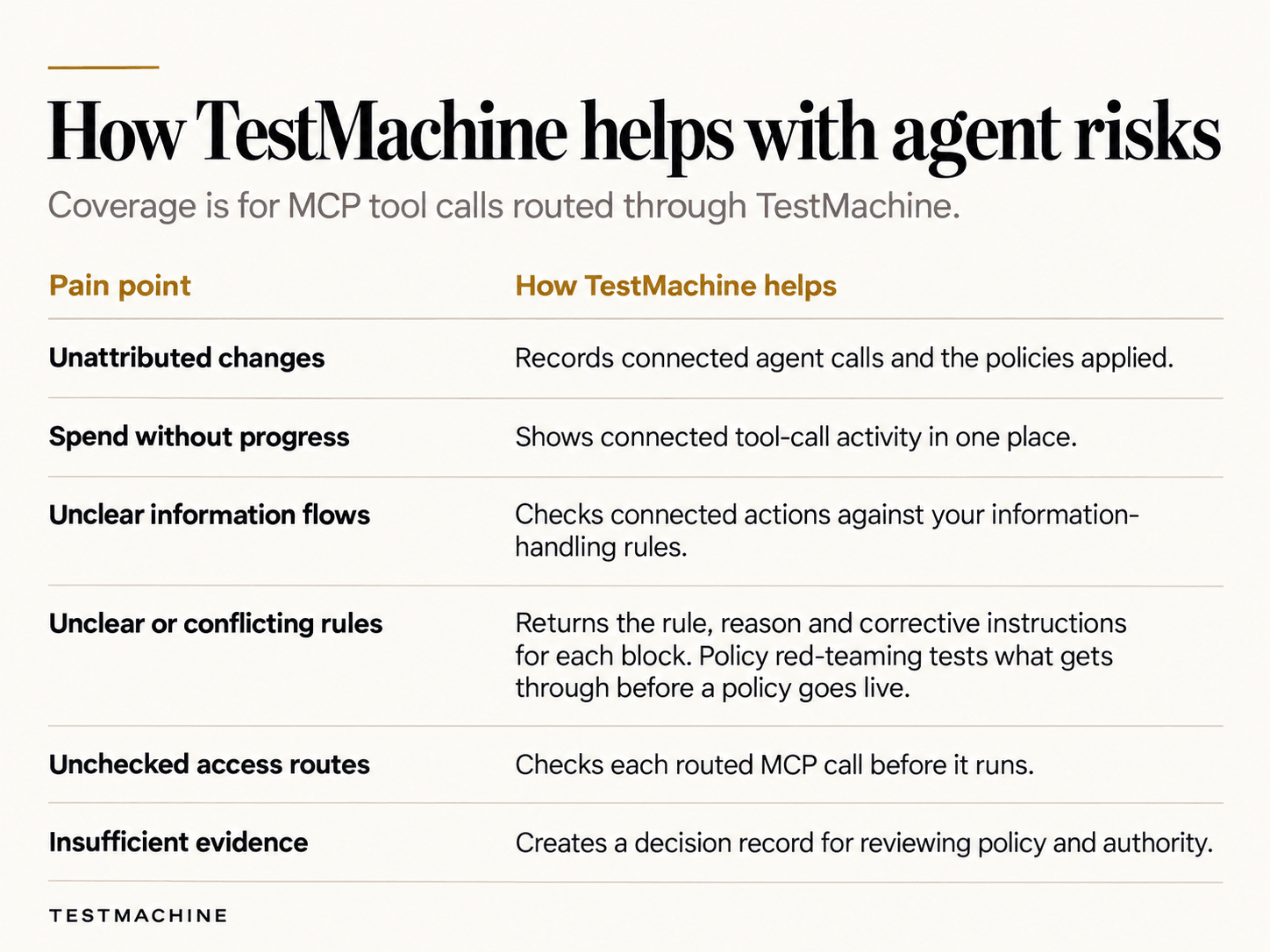
TestMachine makes connected agent actions reviewable
TestMachine observes MCP tool calls routed through its gateway. Teams use that activity to develop policies. TestMachine red-teams policy clauses through the same checks used to enforce them, looking for actions that should be blocked but get through.
During use, approved policies allow or block routed agent calls before execution. People review the decision record and own policy revisions, which return to testing before approval and assignment. Actions outside the gateway need their own safeguards.